A Human Geographical Analysis of the Dreisam River

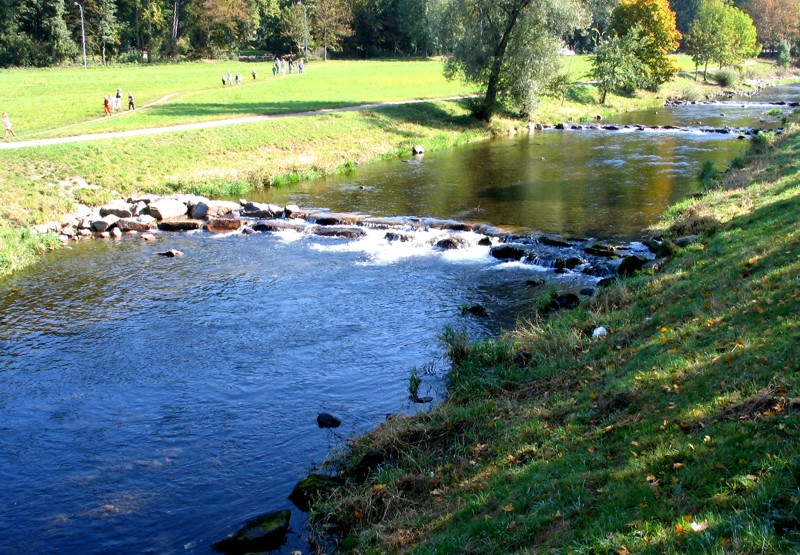
We, two wandering Americans, have stumbled upon the wonderfully charming city of Freiburg, located in the foothills of the Schwarzwald in the South of Germany. This area is rich with wineries, mixed forests, and happy Germans. Running through the center of the StadtZentrum, or city center, is the shallow River Dreisam, running from east to northwest, which was at one time leveled and straightened to mediate urban floods. Now seen as a recreational resource in the midst of this bustling little town, the Dreisam flows openly (unpiped) beneath automobile and pedestrian bridges, and is peppered with cafes and grassy meadows. Along side it run bicycle paths that have honestly become the fastest (and coolest) way to move from east to west through the city, granting one an otherworldly, subterranean passageway to their destination. The river is also channeled into Baechle, or the very small canals that run alongside the cobbled streets of Freiburg, lending the city part of its charm. In an effort to study the aspects of a green urban space such as this, we are examining the ecological, economical, social, and political themes around the current state of this resource. We invite you to join us.

Thursday, July 21, 2011

(More) Room for a River

An Interview with Lothar Mülhaupt and Theo Kästle of Burger für Eins, and the Making of a Grassroots River Restoration

Lothar used to take his grandson down to the river and they would enjoy time with the animals and plant life. When the city continued to be plagued by massive floods, the city water department placed large boulders along the banks in an attempt to mitigate the flooding. The great flood in 1896 uprooted many trees that resulted in the destruction of the Schwabentorbrücke (a major city bridge, below), and so with that memory still in the city’s awareness, small trees were cut down along the banks as another means of preventing flood damage.


Both of these actions made the river inaccessible for children in many places, and the loss of trees disrupted habitat and the natural ambiance. Over the years, however, more trees grew, and so did those children who once played along the Dreisam’s muddy banks. At this time, most Freiburgers considered the river as nothing more than a water channel – a piped, utilitarian construction serving the industrial and municipal needs of the city. It was not a source of recreation, nor did most people consider it habitat. And then, little by little, university students began wandering down into the river in the summer time, cooling cases of beer in the chilly waters while relaxing on the banks. Other citizens, young and old, took notice of this. They began to realize that this place could indeed be a cultural asset for relaxation and rejuvenation – as well as a source for that sought-after experience of nature in an urban environment. Over the years, the banks became crowded by families, couples, elderly, children, artists, musicians, students, and vagabonds – and this began to attract the interest of Freiburg’s city planners. Soon, boardwalks were built along side the river, serving walkers, cyclists, and in-line skaters, creating a quaint and efficient transit corridor from East to West and back again. Old bridges were converted to pedestrian use only, creating peaceful places for quiet contemplation above the gentle river waters – in the middle of a bustling city. And as one can see from the survey we just published, by 1999 interest in restoration was strong, and it would only be a matter of time before those voices would find legs and feet.


Burger für Eins (BFE) is a neighborhood association that has operated in Freiburg for many decades now, hosting cultural events throughout the year and taking care of the various concerns of neighborhood life. One year ago, it was decided that something should finally be done about the Dreisam in terms of its ecology and recreation function. Although Lothar had not been down to the river with his grandson or otherwise for years – in part due to a gratefully successful battle with cancer – when the topic came up, Lothar was the first to volunteer. As a 10-year retiree, he has more time on his hands, which he now devotes to the project. Lothar was originally trained as an electrical engineer and worked on various military air projects - a very different world – but as a result his mind is very technically trained, and his heart beats to the rhythm of the Dreisam.

Among the difficulties that Lothar and Theo faced was discerning who actually has jurisdiction over the Dreisam. As it turns out, this is decided quite logically though in a typically convoluted and bureaucratic manner. Stewardship of local waterways is determined the median annual water flow, granting the Dreisam’s juristiction to the state of Baden-Wuerttenberg while its smaller headways are controlled by the cities and towns through which they pass. The banks of the river, however, are privately owned (unless owned by the city). As one could imagine, it was a difficult task indeed to find a location where riverbed expansion could be easily negotiatied. It seems, however, Lothar, Theo, and BFE had exceptional timing when they approached this situation – "running into open doors," as it is said in German. There exists a segment of the Dreisam near BFE’s neighborhood that is just south of a wide open patch of land controlled by Baden-Württenberg, and only part of this land is currently used for state-sponsored farming. The state has already recognized the patch is poor farmland and would be willing to locate operations elsewhere, so land for the Dreisam’s expansion is indeed available. The segment is located between Badenova Stadium and the new University Stadium. The remaining requirements are permission from the state to alter the waters of the Dreisam, and of course funding.


The headquarters for BW’s water management is in Loerach (south of Freiburg) and the Dreisam is overseen in particular by Eric Linson. When approached, Linson was very receptive to Burger fuer Eins (BFE) and their intentions to initiate a restoration project. After some discussion, BFE learned that the EU has recently issued the Water Framework Directive (that we learned of from Joerg Lange), which mandates that all partially natural urban river systems in the EU be restored by 2020. This would be a considerable source of funding. It was also realized that the EU uses regional environmental authorities (in this case Regilium Prisilium) to choose offset projects when companies develop land. And so, Linson organized efforts for a recent offset need (due to a new railway from Karlsruhe) to be allocated to a small Dreisam restoration project, granting the project even more funding. BFE then approached Kamm + Pohla, a small, local landscape architecture firm, to design the plans for a renaturalization of the chosen segment. The goal of this design is to give the Dreisam some breathing room – widening its banks into a more legitimate floodplain complete with small islands to help slow the current – offering wildlife a better chance to thrive while protecting the city from flooding. The space will also include largely expanded recreation opportunities for children, families, and students. The original landscape for the project included several more hectares of land to the north of the Dreisam, but a municipal water pipeline stood in the way. The pipeline could be moved, but it was repaired only five years ago, so this may not be a realistic option for another 20 years. And so, a compromise was reached to create the floodplain as wide as possible until the pipe could be moved. Lothar noted that this is probably a blessing in disguise, as the original plan was quite ambitious, and may have caused pullback from other members of the community who aren’t ready for too much change too fast. The current design is quite inspiring, and we will be posting it soon.

We were very inspired and encouraged to stumble upon this small group of movers and shakers, and we hope that this project will bring all that its potential promises to the Dreisam, their neighborhood, and the city of Freiburg.

Wednesday, July 20, 2011

Summer 1999: An Urban River Snapshot

After a little more digging, we were able to get in touch with Dr. Thomas Uhlendahl (many thanks to Jörg Lange and Nicole Jackisch). Thomas recently wrote a PhD thesis titled "Public participation in river basin management on the local level within the context of the Water Framework Directive," and it includes several chapters on the Dreisam. During our interview with him, we discovered the existence of a survey conducted in the Summer of 1999 for the purpose of illuminating the relationship between the Dreisam and its people. The survey comes from a study entitled "GEWÄSSER-ENTWICKLUNGSPLAN" by Jörg Haferkorn, Joachim Loritz, and Stefan Amann. We have reproduced excerpts of this study in English below. Our translation was aided by Google Translate and many grammar lessons from our lovely German teacher, Karen. The most interesting finding for us was the overwhelming support at least as early as 1999 for a restoration of the Dreisam to its natural state (or something closer to it). Further investigation has yielded the knowledge that this sentiment has only grown over the past decade, which we are excited to describe in detail in our next post. Until then, here are the excerpts from that study, giving us a snapshot of how things were along the banks of the Dreisam a decade before:

Recreational Function of the Dreisam River
4.1 Introduction
The waters of the Southern Upper Rhine Directorate / Upper Rhine area Waldshut is responsible for the development of Dreisam waters in the area referred to as “planning and implementation.” This requires the creation of a water development plan. It is intended as a basic planning tool of the current state, including the development goal and the long-term development needs in general, as well as concrete implementation options.
The pioneering aspects of water development here are for the “ecological river” as a product of nature and space utilization, and both influence each other.
Especially in urban areas, the growing use and significance of the watercourse as a place of relaxation, experience or recreation in “nature” has been observed. At the same time there are efforts for the highest ecological protection and highest economic uses (so-called restrictions).
To create a concept for the development of the inner-city river, it requires the knowledge of the "relationship" of the city or the city dwellers to urban rivers.
In coordination and close cooperation with the Southern Waters Directorate, the Upper Rhine / High Rhine region Waldshut and the local authorities were established for the determination of the relaxation function parameters established in August / September 1999 in the city of Freiburg. To get an impression of that "relationship” between the city and river, a survey was also carried out, as well as reports on the conditions, content, and results.

4.1.1 Recreational Functions of the Dreisam
Due to the diverse needs of our leisure society, recreation in the everyday environment preferably takes place “at our front door." The Dreisam is not only directly in front of many front doors, but also running centrally through the main city of Freiburg. Not only Freiburgers themselves, but many commuters and visitors use the river and its riparian areas on weekends, during breaks, and after work as a relaxing element as well as a place to experience nature in urban areas.
Relaxation is sought in the form of walking, sitting and sun bathing, swimming, and barbecuing. In addition, in urban areas exist the most well constructed boardwalks, frequently used as routes for joggers, cyclists, and inline skaters (although many of these users of the Dreisam area could not be included in this survey for logistical reasons).
Besides the obvious and strong use of the Dreisam as a place of recreation and leisure activities, the relationship between humans and nature in the city is important with regard to the overall plan of water development.

4.3.1 intention of the survey
To get an impression of the ways the Dreisam is being used and to what extent.
The target group included Dreisam users who choose to spend part of their free time on or by the water and who were ready and willing to give 10 - 15 minutes of their time to answer the questionnaire.

4.3.2 Boundary conditions and content of the survey
Period: hot weather period from Aug 25 – Sept 10, 1999
10 survey appointments were created at different times of day and days of the week
Survey Area: Dreisam boardwalks and waterside sites in the city Freiburg area
Interview duration: 10 - 15 minutes per questionnaire
Number of respondents: 100

4.3.3 The questionnaire
The questionnaire is divided into three parts. In the first part, general (anonymous) information about the subject is asked, then the subject is asked about the recreational use of Dreisam. In another part individual subjects have the option to name additional important or unimportant issues. The person also has the option to express criticism or suggestions for improvement. “Restoration of the Dreisam” was given as an example, with an aerial image shown of the original appearance of a small riparian meadow.


4.3.5 Summary and interpretation of results
There were 57 females and 43 males interviewed, of whom 76% are living in Freiburg. The survey was aimed at all age groups, reaching both children and retirees over 70 years. Most people (over 40%) represented the age group 21-30 years.
98% said they use the Dreisam as a place of recreation. 64% walk on the Dreisam, most (30%) between 1 and 50 times per year.
87% walk or dwell on the River. Again, the majority of 1-50 times per year. 5% would like more benches or seats stones to relax and unwind.
29% said they bathe in the Dreisam. The average number of bathing days was 17 (per summer). 16% of the respondents proposed to create additional deeper swimming holes or shallow gravel beaches. Many criticized the risk of injury by broken glass in the riverbed of the Dreisam.
13% have made a fire or grilled at the Dreisam at least once. 70% were in favor of creating official barbecue areas, emphasizing several times that only a few barbecue places should be created.
The accessibility was predominantly (47%) classified as good. 91% considered it either very good, good, or at least moderate. 21% of them considered accessibility an important issue. 9% considered accessibility poor to very poor. Among other things criticized was the lack of signage as well as the limited access for pedestrians with wheelchairs.
The waste is either disposed of either through the public garbage can (37%) or taken home (36%). 21% use both. 2% admitted they did not dispose of their rubbish. On the subject of waste, the most criticism was voiced. 37% of all respondents wish that more trashcans be placed along the river, and the already existing cans should be emptied more frequently. In the city center (Kaiser Bridge), packaging waste from the pizzeria present a challenge to tree frogs, and some suggested the company should take care of the removal.
90% of all respondents would be in favor of a restoration measure for the Dreisam. 6% are against such a measure, and 4% had no opinion on this topic. No significant correlation in the responses could be seen on the topic of whether the respondents knew why the Dreisam was straightened (24% knew and 76% did not).
The most important issues for respondents were the experience of nature and river restoration with 73%, the chairs and relaxation factor with 72%, and walking with 65%. The garbage problem was important for 58%, and this topic had most criticisms and suggestions. The issue of accessibility was important for 42%.
The least important issues were swimming (32%) and fire/grilling with 23%.
While there were other criticisms and suggestions, they cannot directly be assigned to one of the topics listed. There were criticisms about the noise pollution from the roads and the need for more dog waste stations. The most common suggestion was to plant more trees.

Conclusion
Although the survey cannot be considered as representative for Freiburg – its target group are people who already use the Dreisam as recreation - it is clear that recreation is an important concern for Freiburgers and the commuters and visitors of Freiburg. Respondents were overwhelmingly positive about a potential river restoration. It was Important to them to eliminate the many small "disturbances of the natural experience,” caused by garbage, noise, dog feces, broken glass, etc.
On some issues (e.g. accessibility, waste) a more detailed spatial analysis would be illuminating. Ideally significantly more surveys will be conducted, especially for contexts not possible in this case. Moreover, a survey related to accessibility of the disabled would be recommended.

Tuesday, July 19, 2011

A little bit of History

So Andrew and I have finally cracked into Joerg Lange's Die Dreisam. It is every bit the treasure chest we thought, with old photos of the Alte Dreisam (Old Dreisam) before it was straightened as it wound through agriculture lands, the flood of 1896 that tore down the Schwabentorbruecke Bridge, and general riparian mayhem. Joerg has written a great history of the river up until the 1920's. Translated and shortened into a numerical timeline it goes a little something like this:

1809-1811: Partial deforestation of the Schlattwalds (Schlatt Forest)
1831-1842: Planning and Construction of Dreisam Canals (Made politically possible by the expulsion of Napoleon by the Prussians)
1820: Situation Plan drawn up by Johann Gottfried Tulla
1835-1838: Damming of the Dreisam under Tulla completed
1837-1843: Construction of Dreisam Canals at Eichstetten and Bahlingen
1845-1855: Complete clearing of Schlattwalds. The resulting agricultural and grazing land is raffled among the citizens. With the proceeds from the sale of timber, the timber is formed Checkout, a municipally owned Kreditanstalt (including Eichenstaemme 1530)
1852: Founding of Entennest-irrigation cooperative
1865: Completion of irrigation systems in Entennest and straightening of approximately 2700 m of the old Dreisam running between Bahlingen and Riegel as well as from 700 m at Eichstetten
1924/25: Regulation between the bridge over the old Dreisam and Bahlingen 1944:
1958: The last documented + caught Lachs (salmon) out of the Elz-Dreisam system

Thursday, June 23, 2011

A Short Tour


See this guy almost everyday.


End of the path! On this side at least.


Perfect place for a mittagspause


Extrablatt cafe! Our office.


Andrew and I posting this!


Relaxing


Playing


One of the bächle at night. Ein bisschen eery.


My bike loves having its photo taken. Seriously, it sometimes wont get out of the picture.

When a city serves habitat, that habitat serves its citizens. How do we quantify this for effective planning and design?

I have just read an excellent paper titled: "Toward Ecosystem Services as a Basis for Design" by Windhager et. al., and its perspective has significantly raised the stakes for environmental design. ‘Ecosystem services’ is a term adopted by economists to describe the measurable benefits that the natural environment provides to humans at no cost, benefits we would have to provide for ourselves if our surroundings ceased to provide them (if even possible, at great cost). From the paper: “These services include the manufacture of critical ‘products’ such as breathable air; fishable, swimmable, and drinkable water; cycling of atmospheric gases, nutrients, and waste; and a host of others, including benefits such as ecotourism, derived from the primary ecosystem services.” Other less measureable services include public health and community benefits derived from nature contact, such as recreation opportunities, improved physiological function (particularly healing), improved cognitive function (particularly in children), stress and anxiety reduction, greater community cohesion and participation, higher property values near green space (this of course is measurable), and even a higher inclination to proactively care for the environment. Researchers are just scratching the surface with many of these secondary services, as the underlying mechanisms for some of them remain mysterious. For the purposes of this paper, mainly primary services are considered.

While all environmental researchers are aware of the myriad ecosystem services granted from a healthy ecosystem - even an urban one - and an increasing number of environmental designers, architects, and regional planners are as well, coordination of these parties for effective design and maintenance of urban landscapes that support those services remains a critical challenge. The paper identified performance assessment as a significant missing link in the effort to legitimize professed environmental design goals through existing certification processes such as LEED and more recently SITES. Too often are credits and certifications awarded for initial design and construction of buildings or landscape installations without periodic assessment of the performance of such sites with regards to their actual overall "sustainability" and ecosystem support.

Designing, building, and testing the quality and quantity of ecosystem services then serves several goals: supporting the health and well being of urban environments for people, promoting the myriad ecosystem services that ecosystems are capable of providing - and thus encouraging public support for their enhancement in policy and design, providing a robust public argument for ecosystem protection and regeneration in general, and insuring quantifiable returns on investment from the costs of LEED or SITES design, construction, and maintenance. In order to make this process more effective, more research is needed to quantify these ecosystem services and their mechanisms in general, and better methods and models are needed to measure the barriers, requirements, and indicators of success for their perpetuation on specific sites. Without an effective framework for assessing these services in response to design efforts that promote them, their promotion will not gain ground in the realm of policy, funding, oversight, and regional planning at a national or global scale. In addition to these research needs, better communication is necessary between researchers, designers, builders, occupants, planners, and funding agencies. As the paper quotes, the line between these players must necessarily be blurred.

With regards to our project on the Dreisam River, it will be beneficial to first identify the ecosystem services offered by the Dreisam. One way to recognize the significance of the river, from the ecosystem services perspective, is to imagine the city of Freiburg without the Dreisam. What else would be missing? What if this river, like so many in American cities, had been piped and buried? We will write a post about this as a larger idea soon. As for the planning and design of the Dreisam, there are indeed many players involved. Which of these players are aware of the Dreisam’s many ecosystem services? How could they be educated about them so as to increase their support for healthy environmental design and policy? How could the vast environmental research facilities of Freiburg be better linked to urban designers, planners, and policy makers?


A student reading
Two collapse after cycling
Jogger passes by.
Room for the ducks. Several of these had just reached adulthood.
Hard to quantify: peaceful relaxation.
A river warrior hard at work while a family enjoys their serene surroundings.
Location: Extra Blatt Cafe (the new Uber Dreisam Cafe)


Tuesday, June 21, 2011

Player #1: Jörg lange

SO, Andrew and I had our first meeting with Important Person Nummer Einz: Jörg Lange, author of magical book Die Dreisam, a book that will hopefully prove to be resoundingly helpful in our project, despite being written entirely "auf Deutsch." We're working on a slow translation. This book, broken out from its shiny plastic, instantly became ein Schatzkiste - a treasure chest - filled with beautiful photographs from the early Rhine (the larger river system from which the Dreisam is fed), maps of the changing topography, and almost stop-motion-like photographs of various development and restoration projects that have happened along the river in the last few decades. This book WOULD be our entire project, if only we could decipher its secret code: Deutsch. But then I suppose we would be rendered useless, really.


So last friday morning we both hustled to a very unprepared interview with Jörg in his hard-to-locate office above Süden, the wonderful local-produce restaurant located in our very own Vauban. We started off our interview with what we thought were some good warm-up questions, asking him if he could give us a brief overview of the history of the Dreisam, to which he responded that it was "not possible," as well as asking him which themes he considered to be the most crucial right now concerning the Dreisam, whether it was political, economical, sociological, or ecological, to which he shrugged and replied "yes, all." He seemed a little exhausted with us already, so Andrew and I nervously eyed each other and decided to go for the distantly-knowledgeable-yet-humble approach of probing him with questions that hinted to more of a background in the history of the Dreisam than we perhaps truthfully knew, which worked out quite nicely and soon he opened up to us about his skepticism with the potential effectiveness of the newly elected Green Party to be able to get any good legislation passed through the lingering legacy of the 60-year reign of the Christian Democratic Party. He informed us of the miscalculation of the architect Tuller when he straightened the Rhine (better for transportation and trading), mis-measuring the allotted space for a dam and leaving only .5 meter where there should have been 1 meter extra in case of flooding.
          With the straightening of the river, the habitat of the river bed changed dramatically, as straightening of a river increases flow rate which results in increased sedimentation, altered area of flood plains, change in species composition as plants are selected towards resilience of faster river flow (such as stronger root systems), and competition breaks out between dry species and special adapted flood-plain species (silver willow, silver poplar). Some of these flood plain species have some cool attributes, including relying on Lenticels (such as Wild Cherry); cells that allow the plant to breath through its bark when the root systems are drowned in water in heavy flooding. The Dreisam is extremely narrow, as are its banks, with walk/bikeways running along the waters edge along most of its length, leaving just enough room for some seriously thick vegetation and a grassy ledge suitable for picnicing or siesta-ing. This is enough habitat for many bird species, and small fish. However, one of the biggest goals of longterm NGO involvement in the river's management, is the re-introduction of salmon, or "wundefische." In 1850 the river Rhine and all it's connecting distributaries were abounding in salmon. 1 million salmon would migrate up the Rhine each year, until the Sandoz fire in Switzerland in 1986 that released tons of agrochemicals into the river, turning it red.  However, travel up the Rhine is made virtually impossible by the 10 different dams from Strasbourg on, created to manage the river's flow. 2 of these dams have made efforts to assist the salmon; at Gumshyne Dam a salmon bridge was created to assist the natural spawning cycle of the fish, and is also used as an educational resource for visitors, who can view the salmon traveling through. Excursion-zeit!
       J
örg informed us that all of these dams and power plants located along the river are located in France, making it a political hurdle for these groups, as France is more interested in power than the welfare of the "wundefische," and was granted the rite to use the water how they please after WWI. This is likewise a similiar hurdle in dealings with the Netherlands, with the Haringvlietdam, creating an enormous barrier for the salmon. In 2010 the Dutch government had pledged to open the dam, but a change in government yielded an a change in plans. The dam is still closed. I'm curious about this case, because after our meeting with Jörg I still had a few questions. What environmental implications for Holland would opening the dam mean? I doubt its as simple as I'm "made it" here, villianizing the new Dutch government. In fact, Jörg painted a pretty picture of Germans in terms of their support for the Dreisam's health, while also suggesting that France and the Netherlands have little interest in restoring the Rhine. But what's really going on here? It's not that German's are the most compassionate and environmentally responsible folks around, was this just a little country-bias? Something to be explored a little more. 
       We encountered a similar curiousity when Jorg told us about the next major project for restoring the dreisam which would be to "give it more space." The only question is if there is enough money. I asked Jorg how the community living in that area feels about this project. He laughed at my use of the word "community" asking if Freiburg wasnt the community in question and clearly Freiburg is in support of the Dreisam. Andrew clarified that we're using the term community to refer to the smaller community within Freiburg that may have a different stake in development of the Dreisam, for example, a residential community in that neck of the woods who might have some "qualms" with expanding the river. He kind of scoffed at this as well, as clearly the Freiburg community is in support.   For Andrew and I however, this was a huge shock, because we could easily imagine a project like this back in the States being met with avid opposition from people who would argue that widening a river in their backyard would perhaps bring virus-carrying mosquitoes, add a dangerous element to their neighborhood, possibly encroach on their property, not to mention construction and maintenance noise and potential costs. 


       Overall our meeting with Jörg was a HUGE success. He is a very busy man and we were extremely grateful that he not only took time out of his busy schedule to speak to two Americans on a topic we know so little about, but he gave us a copy of his big glossy magic book. He led us in some great directions, and connected us to a few other players we might seek out. 


        *A Short Disclaimer: I dont claim that everything I've written here is fact. Most of the information here today was received in Genglish from Jörg Lange, and Wikipedia links obviously come with their own potentially dubious sources. These are a mere wading-into of these issues, some to be explored in much deeper, scholarly-researched steps. Any additional information or corrections anybody has would be wonderfully appreciated*


Monday, June 20, 2011

Between the River and its People

Is there a symbiosis between the river Dreisam and the community of Freiburg? We’re here to study the dynamic between River and Society. What does it mean to this community to have a resource like the Dreisam running through it? There are tons of benefits of having a resource like this in the center of an urban environment. Having a river supports the ecology of an area, increasing biodiversity by providing habitat for different species of flora and fauna, and even providing critical transportation routes for aquatic species like salmon. It creates a valuable public space used for recreation, allowing space for barbecuing, walking or biking, or laying in the grass with friends. It allows people to repair the loss of connection with nature, a sad attribute of our post-industrial development and increasing isolation from community and place. A green space like this can help to increase this sense of place, providing a connection to resonating landscape of an area. Furthermore, a resource like this supports local economy by increasing property values of neighboring businesses and residential areas. Most crucially, a river has multiple public health benefits, including providing space for physical activity, providing habitat for air filtering plant species, and mitigating the effects of the Urban Heat Island [the effect of rising air temperatures as humidity and volatile organic compounds (VOCs) from power plants, cars, etc. are trapped in the immediate atmosphere, raising the temperatures of dense urban environments].
With all these seemingly positive effects, we have to ask, is the Dreisam a “successful” public resource? Are people pleased with this green public space? How is the Dreisam managed? Is it considered “healthy” as an ecological environment? In what ways is this health measured and monitored? What policy is in place to protect the Dreisam? How does urban design influence the Dreisam and vice-versa? What groups are dedicated to the cause of the Dreisam? How does the community of Freiburg feel about the reclamation efforts made by various NGO’s in the area to expand the river into its original flood-plain beds? These are just some of the questions we plan to explore in our study of the Dreisam.
Through literature reviews, relevant excursions and interviews conducted with various key-players in the formation and conservation of the Dreisam, we plan to set upon a detective trail to assess whether this is a success story of a green resource and whether something like this could be implemented somewhere else. Specifically, we want to take away from this experience knowledge about the management of a river system and whether any of these strategies are viable for river systems in US cities.