Lothar used to take his grandson down to the river and they would enjoy time with the animals and plant life. When the city continued to be plagued by massive floods, the city water department placed large boulders along the banks in an attempt to mitigate the flooding. The great flood in 1896 uprooted many trees that resulted in the destruction of the Schwabentorbrücke (a major city bridge, below), and so with that memory still in the city’s awareness, small trees were cut down along the banks as another means of preventing flood damage.

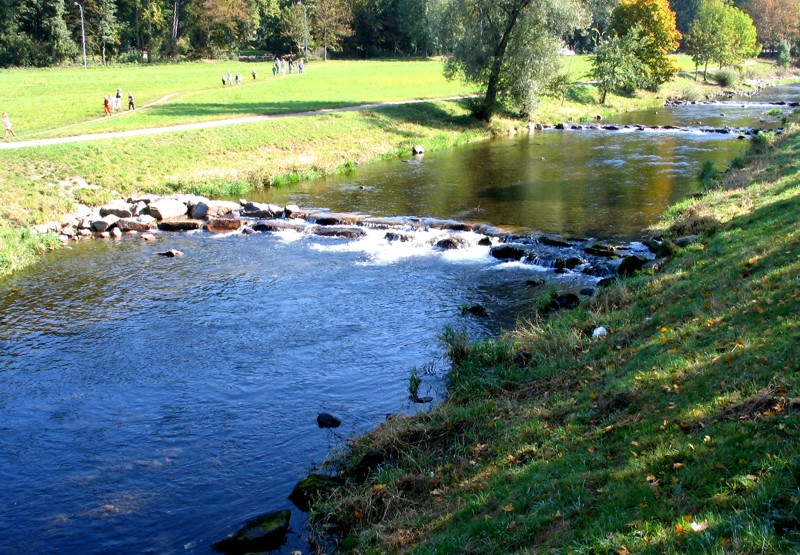
Both of these actions made the river inaccessible for children in many places, and the loss of trees disrupted habitat and the natural ambiance. Over the years, however, more trees grew, and so did those children who once played along the Dreisam’s muddy banks. At this time, most Freiburgers considered the river as nothing more than a water channel – a piped, utilitarian construction serving the industrial and municipal needs of the city. It was not a source of recreation, nor did most people consider it habitat. And then, little by little, university students began wandering down into the river in the summer time, cooling cases of beer in the chilly waters while relaxing on the banks. Other citizens, young and old, took notice of this. They began to realize that this place could indeed be a cultural asset for relaxation and rejuvenation – as well as a source for that sought-after experience of nature in an urban environment. Over the years, the banks became crowded by families, couples, elderly, children, artists, musicians, students, and vagabonds – and this began to attract the interest of Freiburg’s city planners. Soon, boardwalks were built along side the river, serving walkers, cyclists, and in-line skaters, creating a quaint and efficient transit corridor from East to West and back again. Old bridges were converted to pedestrian use only, creating peaceful places for quiet contemplation above the gentle river waters – in the middle of a bustling city. And as one can see from the survey we just published, by 1999 interest in restoration was strong, and it would only be a matter of time before those voices would find legs and feet.
Burger für Eins (BFE) is a neighborhood association that has operated in Freiburg for many decades now, hosting cultural events throughout the year and taking care of the various concerns of neighborhood life. One year ago, it was decided that something should finally be done about the Dreisam in terms of its ecology and recreation function. Although Lothar had not been down to the river with his grandson or otherwise for years – in part due to a gratefully successful battle with cancer – when the topic came up, Lothar was the first to volunteer. As a 10-year retiree, he has more time on his hands, which he now devotes to the project. Lothar was originally trained as an electrical engineer and worked on various military air projects - a very different world – but as a result his mind is very technically trained, and his heart beats to the rhythm of the Dreisam.
Among the difficulties that Lothar and Theo faced was discerning who actually has jurisdiction over the Dreisam. As it turns out, this is decided quite logically though in a typically convoluted and bureaucratic manner. Stewardship of local waterways is determined the median annual water flow, granting the Dreisam’s juristiction to the state of Baden-Wuerttenberg while its smaller headways are controlled by the cities and towns through which they pass. The banks of the river, however, are privately owned (unless owned by the city). As one could imagine, it was a difficult task indeed to find a location where riverbed expansion could be easily negotiatied. It seems, however, Lothar, Theo, and BFE had exceptional timing when they approached this situation – "running into open doors," as it is said in German. There exists a segment of the Dreisam near BFE’s neighborhood that is just south of a wide open patch of land controlled by Baden-Württenberg, and only part of this land is currently used for state-sponsored farming. The state has already recognized the patch is poor farmland and would be willing to locate operations elsewhere, so land for the Dreisam’s expansion is indeed available. The segment is located between Badenova Stadium and the new University Stadium. The remaining requirements are permission from the state to alter the waters of the Dreisam, and of course funding.

The headquarters for BW’s water management is in Loerach (south of Freiburg) and the Dreisam is overseen in particular by Eric Linson. When approached, Linson was very receptive to Burger fuer Eins (BFE) and their intentions to initiate a restoration project. After some discussion, BFE learned that the EU has recently issued the Water Framework Directive (that we learned of from Joerg Lange), which mandates that all partially natural urban river systems in the EU be restored by 2020. This would be a considerable source of funding. It was also realized that the EU uses regional environmental authorities (in this case Regilium Prisilium) to choose offset projects when companies develop land. And so, Linson organized efforts for a recent offset need (due to a new railway from Karlsruhe) to be allocated to a small Dreisam restoration project, granting the project even more funding. BFE then approached Kamm + Pohla, a small, local landscape architecture firm, to design the plans for a renaturalization of the chosen segment. The goal of this design is to give the Dreisam some breathing room – widening its banks into a more legitimate floodplain complete with small islands to help slow the current – offering wildlife a better chance to thrive while protecting the city from flooding. The space will also include largely expanded recreation opportunities for children, families, and students. The original landscape for the project included several more hectares of land to the north of the Dreisam, but a municipal water pipeline stood in the way. The pipeline could be moved, but it was repaired only five years ago, so this may not be a realistic option for another 20 years. And so, a compromise was reached to create the floodplain as wide as possible until the pipe could be moved. Lothar noted that this is probably a blessing in disguise, as the original plan was quite ambitious, and may have caused pullback from other members of the community who aren’t ready for too much change too fast. The current design is quite inspiring, and we will be posting it soon.
We were very inspired and encouraged to stumble upon this small group of movers and shakers, and we hope that this project will bring all that its potential promises to the Dreisam, their neighborhood, and the city of Freiburg.

No comments:
Post a Comment